
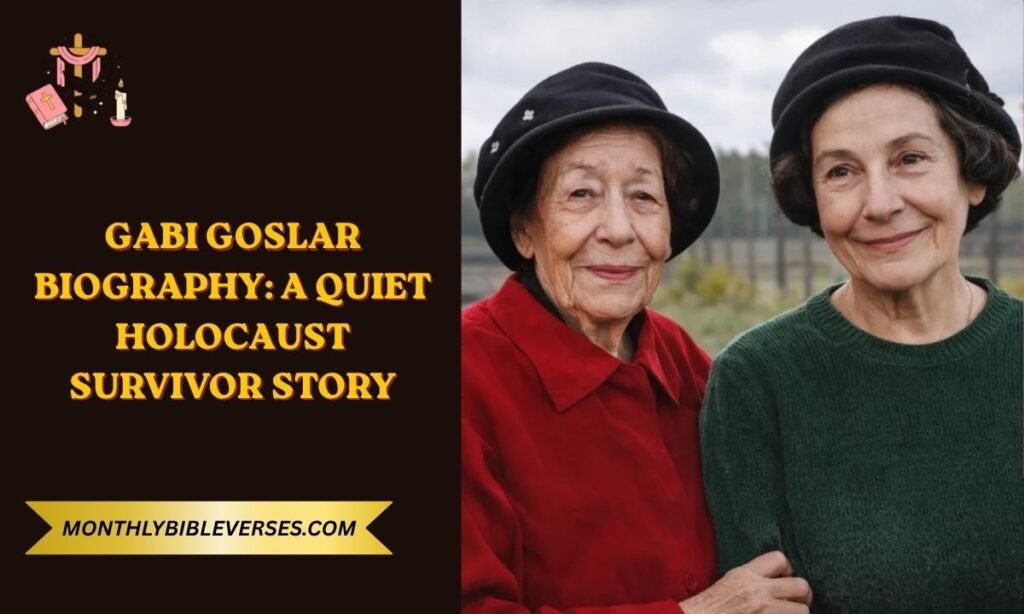
Some stories enter history loudly, carried by diaries and films and global recognition. Others arrive quietly — woven into the fabric of memory, passed through family, and preserved not in headlines but in the simple fact of a life that continued when so many did not.
Gabi Goslar belongs to the second kind of story. Her full name was Rachel Gabriela Ida Goslar, and she was born on October 25, 1940, in Amsterdam — the same city where, just a few streets away, a girl named Anne Frank was growing up in the same narrowing world.
Gabi’s older sister, Hannah Pick-Goslar, would become known worldwide for her testimony about that friendship and about what happened when the Nazis came for the Jewish families of Amsterdam. Gabi was younger, quieter, and far less documented. But her survival matters just as much.
Quick Bio
| Detail | Information |
| Full Name | Rachel Gabriela Ida Goslar |
| Known As | Gabi Goslar |
| Date of Birth | October 25, 1940 |
| Place of Birth | Amsterdam, Netherlands |
| Father | Hans Yitzkhak Goslar (died Bergen-Belsen, February 25, 1945) |
| Mother | Ruth Judith Klee Goslar (died 1942 in childbirth) |
| Older Sister | Hannah Pick-Goslar (1928–2022) — childhood friend of Anne Frank |
| Camps | Westerbork transit camp; Bergen-Belsen concentration camp |
| Liberation | April 1945 (Bergen-Belsen) via the “Lost Train” at Tröbitz |
| Post-War Life | Returned to Netherlands; emigrated to Israel; settled in Petach Tikvah |
| Memoir | I Have to Tell Someone (2010) |
Early Life and Family Background
Gabi Goslar was born into a family that had already survived one upheaval before the worst one began. Her parents, Hans Yitzkhak Goslar and Ruth Judith Klee, were German Jews who had fled Berlin in the 1930s after Adolf Hitler’s rise to power made life in Germany increasingly dangerous. Hans had been a respected figure in Berlin, serving as a senior government official — deputy minister for domestic affairs — before antisemitic persecution stripped away both his career and his security.
The family settled in Amsterdam, believing the Netherlands would offer protection. For a few years, it did. But by May 1940, Germany had occupied the Netherlands, and the fragile sense of safety dissolved almost immediately.
Gabi was born into that occupied city. By the time she arrived, Jewish families in Amsterdam were already living under a growing web of restrictions: curfews, yellow stars, banned public spaces, forced school segregation. She never knew a childhood untouched by those realities. Her world, from her very first years, was one shaped by fear, displacement, and the survival instincts of adults who understood what was coming even when they could not prevent it.
Then, in 1942, Gabi’s mother Ruth died in childbirth. The baby did not survive either. Gabi was barely two years old. Her father Hans was left to raise her and Hannah alone in an occupied city where Jewish families were disappearing every week.
Childhood Under Occupation
Gabi’s toddler years unfolded entirely under Nazi rule. Jewish children were banned from public parks, mainstream schools, and most public spaces. The Goslar family — unlike the Franks, who went into hiding in 1942 — remained in their home. Hans made efforts to protect his daughters, including obtaining Paraguayan passports in the hope that foreign documentation might delay deportation. It took some time, but not enough.
Gabi suffered additional vulnerability during these years due to chronic health problems. Recurring ear infections required hospitalizations, leaving a small child fragile and dependent at the very moment when the world around her was becoming most dangerous. She was entirely reliant on her father and her older sister Hannah for protection and care — a dependency that would shape her entire wartime experience.
“Even amidst terror, human decency could survive.” — The acts of compassion Gabi witnessed inside Bergen-Belsen were as formative as the suffering itself.
The Amsterdam that Gabi Goslar grew up in during these years was not the free, open city her parents had arrived in. It was a place of steadily shrinking boundaries — social, physical, legal — where a Jewish child’s world contracted week by week until there was almost nowhere left to stand.
Arrest and Deportation
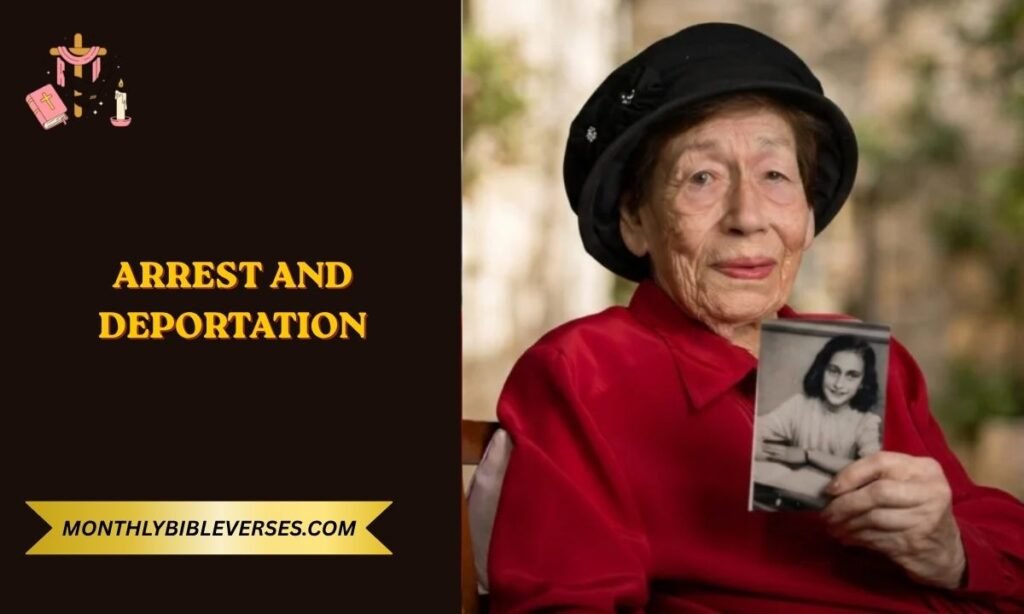
On June 20, 1943, the Goslar family was arrested by the Nazis and deported. Gabi was two years old. The moment marked the end of whatever remained of normal family life and the beginning of a journey through the Nazi camp system that would claim most of her family.
| Date | Event |
| June 1943 | Goslar family arrested and sent to Westerbork transit camp, Netherlands |
| Feb. 1944 | Transferred to Bergen-Belsen concentration camp, Germany (Feb. 15, 1944) |
| Feb. 1945 | Father Hans Goslar dies of typhus at Bergen-Belsen (Feb. 25, 1945) |
| April 1945 | Bergen-Belsen liberated by British forces (April 15, 1945) |
| April 1945 | Gabi and Hannah liberated near Tröbitz, Germany, from the “Lost Train” |
| 1945–47 | Recovery in the Netherlands; brief residence in Geneva with uncle |
| 1949 | Gabi emigrates to Israel at age nine; settles in Petach Tikvah |
Westerbork was the main transit camp through which Dutch Jews were processed before deportation to Auschwitz, Sobibor, and other death camps. At Westerbork, young children were housed in a camp orphanage — a grim institutional structure that reflected both the scale of family destruction and the Nazi impulse to impose bureaucratic order on their own atrocities. For Gabi, Westerbork was her first sustained experience of life inside a camp: hunger, overcrowding, constant uncertainty, and the slow awareness that the adults around her could no longer keep her safe.
Life in Bergen-Belsen
On February 15, 1944, the Goslars were transferred to Bergen-Belsen concentration camp in northern Germany. Because Hans held foreign passport documentation, the family was placed in a marginally better section of the camp — the so-called “Palestinian exchange list” — reserved for prisoners with potential exchange value. The conditions were still horrific: starvation, disease, severe overcrowding, and the complete absence of sanitation.
Bergen-Belsen was not originally designed as an extermination camp, but by 1944–1945 it had become one of the deadliest places in the Nazi system through deliberate neglect. Tens of thousands died there from typhus, dysentery, and starvation.
For Gabi, survival in the camp was inseparable from the care of others. When her sister Hannah fell gravely ill, Gabi was tended to by a woman named Mrs. Abrahams — a prisoner and mother of seven children who extended compassion to others even in conditions designed to destroy it. That act of human kindness is one of the few documented details of Gabi’s camp experience, and it says something important: even in Bergen-Belsen, generosity survived.
It was also at Bergen-Belsen that Hannah had her famous final meetings with Anne Frank, which was held in a nearby section of the camp. Gabi’s presence during this period — as a small child being cared for while her sister sought food and comfort for both of them — places her inside one of the most documented but also most painful chapters of Holocaust memory. Anne Frank died of typhus at Bergen-Belsen in February 1945. Gabi’s father, Hans, died the same month. By the time British forces arrived in April, Gabi and Hannah were the only Goslars left.
Liberation and Survival
Bergen-Belsen was liberated by British forces on April 15, 1945. What the soldiers found there shocked even veterans of the war: tens of thousands of unburied corpses, survivors barely alive from disease and starvation, and children like Gabi who had spent their earliest years in conditions no human being should endure.
Liberation did not bring immediate recovery. Gabi and Hannah were placed on one of the evacuation transports that Nazi authorities had desperately organized as Allied forces closed in — a journey that became known as the “Lost Train” or the Tröbitz transport. The train wandered for days with no clear destination. Many prisoners died during the journey from typhus, exposure, and exhaustion. The train was eventually abandoned near Tröbitz in Germany, where Soviet soldiers discovered it and freed the surviving passengers.
Gabi was four years old at liberation. That she survived at all — given the mortality rates among child deportees at Bergen-Belsen, estimated at roughly nine out of ten — is remarkable not as a miracle but as a fact that demands acknowledgment.
Life After the War
After liberation, the two sisters returned to the Netherlands. Recovery was slow. Hannah required extended hospitalization. Otto Frank — the father of Anne Frank, himself a survivor of Auschwitz — became an important guiding figure for the sisters during this period, helping them find stability in a shattered world.
The girls were eventually sent to live with an uncle in Geneva, Switzerland, where they began the long process of rebuilding. In 1949, at the age of nine, Gabi moved to Israel, settling in Petach Tikvah. There she built a quiet, private life — marrying a man with the surname Mozes and raising a family away from the public attention that increasingly surrounded her older sister Hannah.
Gabi’s choice to remain outside the public eye was consistent with a pattern common among Holocaust survivors, particularly those who were very young during the war. Silence was not denial. It was a form of survival — a way of protecting the life she had rebuilt from the constant re-exposure that public testimony required.
In 2010, however, she did speak. Her memoir, I Have to Tell Someone, offered a deeply personal account of her experiences — one of the few first-person documents of her survival that exists in the public record. It became a significant contribution to Holocaust education, adding a child survivor’s perspective to a historical conversation often dominated by adult testimonies.
The Role of Family Memory
Much of what the world knows about Gabi Goslar comes not from her own public statements but from the testimony of her sister Hannah — and, by extension, from Anne Frank’s diary, which mentions the Goslar family by name and with deep affection. This is itself historically significant.
Gabi’s story illustrates a truth that Holocaust scholars emphasize: history is not only preserved in diaries and official archives. It lives in family relationships, in shared memories, and in the lives that quietly continued after the war ended. Without Hannah’s testimony, Gabi’s name might never have entered historical discourse at all. Without Gabi’s survival, Hannah’s story of protecting a younger sibling through Bergen-Belsen would have no conclusion.
- Hannah Pick-Goslar became a prominent public figure, frequently interviewed as one of the last living people who had known Anne Frank personally
- Hannah passed away on October 28, 2022, in Jerusalem, at the age of 93
- The 2022 Dutch film My Best Friend Anne Frank dramatized Hannah and Anne’s friendship, bringing renewed international attention to the Goslar family story
- Gabi participated in the unveiling of Stolpersteine (memorial stumbling stones) in Germany honoring her parents — small brass plaques marking the last freely chosen homes of Holocaust victims
Why Gabi Goslar’s Story Matters Today?
Holocaust education increasingly recognizes that survivor experiences were not uniform. The youngest survivors — children like Gabi who were carried through the camps before they could form memories or write diaries — have a story that is different in form but not in importance. Their survival is testimony. Their continued existence is a rebuttal to Nazi ideology.
Gabi Goslar’s biography matters for several reasons that extend beyond personal history:
- It represents the experience of thousands of Jewish children whose wartime experiences were shaped entirely by dependence on adults and family bonds
- It demonstrates that Holocaust memory is not only textual — it exists in relationships, families, and lives lived quietly after catastrophe
- Her memoir contributes to the dwindling archive of first-person survivor testimony as the generation of witnesses ages
- Her story connects directly to Anne Frank’s legacy through her sister Hannah, keeping that connection human and familial rather than purely symbolic
- Her advocacy work — speaking on peace, tolerance, and the dangers of antisemitism — ensures that her survival serves a purpose beyond personal memory
A Quiet Legacy
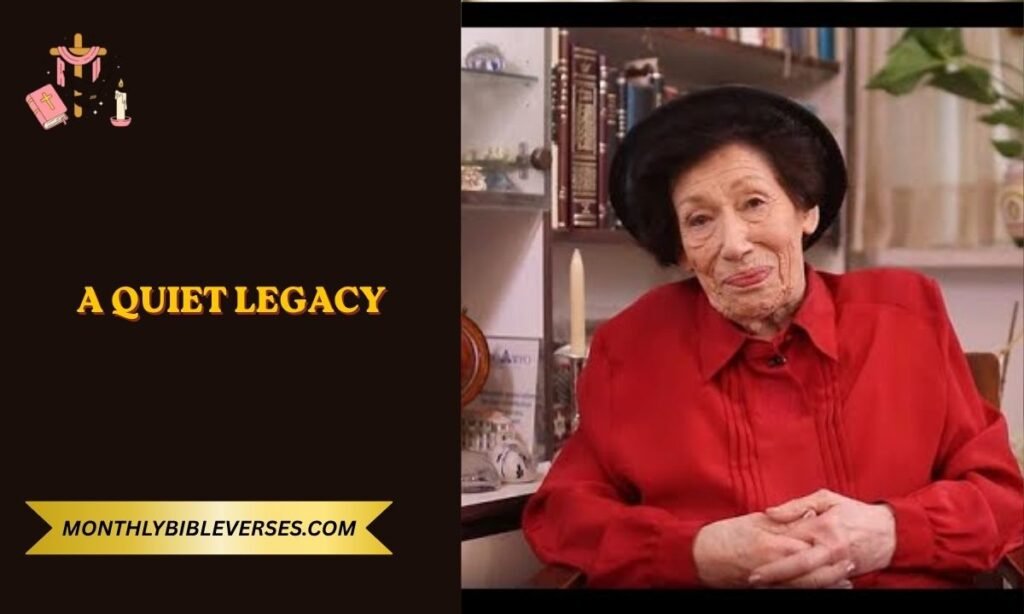
Gabi Goslar never sought fame. She did not define her adult life by her wartime experience the way public figures sometimes do. She built a family in Israel, lived quietly in Petach Tikvah, and for most of her adult life stayed outside the historical spotlight that illuminated her sister so brightly.
But quiet is not the same as unimportant. The very fact that Gabi survived — that a toddler carried through Westerbork and Bergen-Belsen and the Lost Train emerged to build a life, raise children, write a memoir, and participate in acts of remembrance — is itself a profound statement. It says: we are still here. The system designed to erase us failed.
Her legacy is not measured in films or international recognition. It is measured in the memorial stones placed in a German street to honor parents who were murdered. In a memoir written seven decades after liberation. In a family that carries the memory forward. In the generations of students and educators who have encountered her name through her sister’s testimony and found, in Gabi’s quieter story, something just as essential.
Conclusion
Gabi Goslar’s life is a reminder that Holocaust history contains multitudes — loud voices and quiet ones, diaries and silences, public testimonies and private healings. Born into an occupied city, orphaned before she could form clear memories, imprisoned as a toddler, and liberated at four years old, she carried the weight of that history with a grace that never demanded recognition.
She was her sister’s keeper in Bergen-Belsen, and her sister’s memory after the war. She was a child who should never have had to be brave — and who was, anyway. Her story belongs alongside the names we know, not beneath them. That is what a quiet legacy looks like when you look at it closely enough.
Frequently Asked Questions
Who was Gabi Goslar?
Gabi Goslar, born Rachel Gabriela Ida Goslar on October 25, 1940, was a Jewish Holocaust survivor from Amsterdam and the younger sister of Hannah Pick-Goslar — the childhood best friend of Anne Frank.
How was Gabi Goslar connected to Anne Frank?
Gabi’s older sister Hannah was one of Anne Frank’s closest friends in Amsterdam; both families were deported and imprisoned at Bergen-Belsen, where Hannah had her final known meetings with Anne.
What happened to Gabi Goslar during the Holocaust?
She was arrested with her family in 1943, sent to Westerbork transit camp, then deported to Bergen-Belsen where she survived for over a year before being liberated near Tröbitz, Germany, in April 1945.
Did Gabi Goslar’s parents survive the Holocaust?
No. Her mother Ruth died in childbirth in 1942, and her father Hans died of typhus at Bergen-Belsen on February 25, 1945 — just weeks before liberation. Gabi and Hannah were the only Goslar family survivors.
What is the “Lost Train” that Gabi Goslar survived?
The “Lost Train” was an evacuation transport organized by the Nazis as Allied forces advanced; it wandered for days before being abandoned near Tröbitz, Germany, where Soviet soldiers liberated the surviving passengers.
Where did Gabi Goslar live after the war?
After recovering in the Netherlands and briefly living in Geneva with an uncle, she emigrated to Israel in 1949, settling in Petach Tikvah where she built a private family life.
Did Gabi Goslar write a memoir?
Yes. She published I Have to Tell Someone in 2010, a personal account of her Holocaust experiences that became an important contribution to survivor testimony and Holocaust education.
When did Hannah Pick-Goslar die?
Hannah Pick-Goslar passed away on October 28, 2022, in Jerusalem, at the age of 93 — mourned internationally as one of the last living people who had known Anne Frank personally.
How old was Gabi Goslar at liberation?
Gabi was approximately four years old when Bergen-Belsen was liberated in April 1945 — making her survival among the most extraordinary of child Holocaust survivors given the camp’s devastating child mortality rates.
Why is Gabi Goslar’s story historically significant?
Her biography represents the experience of thousands of Jewish children too young to leave written records, demonstrating that Holocaust memory lives not only in diaries but in families, silences, and the quiet lives of those who survived.

Akash is a dedicated writer from the USA, committed to sharing insightful and inspiring Bible verses. With a focus on faith, spiritual growth, and daily encouragement, he aims to provide readers with meaningful scripture reflections to strengthen their relationship with God and enrich their devotional journey.